I love the internet and
social media. I understand there are many not very nice things about it, but it
is thanks to it that I was able to find my long lost relatives in Argentina,
Ukraine, Luxemburg, Israel, Germany and most recently the US and Canada.
It was one regular
working day to me, and I was expecting no surprises. Days like this one
happened before, where I was expecting nothing and all of a sudden, Shlomi
Tolpolar from Germany calls me on Skype saying he is my cousin, or Mikhail
Tolpolar calls my phone from Ukraine and we can barely communicate because I
can't speak Yiddish or Russian. Well, a few days ago it happened again, now
through Facebook. I got a message, out of the blue, from Alik Oshmiansky.
Through his profile was writing somebody named Rachel (or Ruhl) Tolpolar, from
Los Angeles, saying she was a cousin. A few hours later I receive a message
from Shoura Canmore., from Calgary, saying she was my cousin as well! I was
dumbfounded. You would be too. I needed some time to digest it and, mostly, ask
my dad about these possible relationships.
 |
| Ruhl and us - on Skype |
Shortly, this is the
story:
Ruhl and Shoura's mom
was Miriam Ludner, whose maiden name was Tolpolar. Miriam's father was
Velvl Tolpolar, Meyer's brother. Meyer Tolpolar was my great-grandfather. How
did Ruhl knew this? Because her mom would always tell her the story of her
uncle and aunt's murder. Miriam knew all of it, just like we do! Ruhl said the
Tolpolars were not rich, but had a good life, had cows and got milk and cheese
from them.
Miriam was born in
Oliscani, a small village in Moldova, like all Tolpolars. She had 2 brothers,
Haim and Shlomo, and 3 sisters. One of them was Betty, killed in a war bombing
in 1941. Haim wanted to leave Oliscani and ended up in Iasi (Romania). Miriam
followed her brother's footsteps and also moved to Iasi in 1931, the same year
where her uncle was murdered and my grandfather left to Brazil. It was heard
that Shlomo tried to move to Brazil as well, but was killed in trying.
Miriam was evacuated to
Kazakhstan, and that's how she survived. In 1943, when the allies started to
win the war and German power started to dwindle, Miriam was able to go back to
Oliscani, but there was nothing there for her to find anymore. So she went to Orhei,
where Ruhl and Shoura were born. They left Moldova in 1977 to Israel, and then
North America.
 |
| Ruhl showing a picture of a cousin - looks just like my dad! |
Ruhl's family was much
closer to all atrocities committed in the war and suffered much more with
immigration and family displacement. Speaking to her, I had the feeling that my
grandfather found a haven in Brazil, and had the best life he could have
imagined outside Europe.
Miriam always tried to
find the other Tolpolars, but was unsuccessful. Until one day Ruhl was on the
internet and accidently stumbled upon Mamaliga
Blues homepage. So thanks again for the internet and social media, and I
believe more surprises are to come. They always do.




 The Orhei Jewish cemetery is one of the 10 oldest in Europe; it is 450 years-old, whereas the city is 570 years-old. The cemetery is not totally abandoned. There’s a keeper, people also give donations and family relatives repair graves. There are a few Holocaust memorials there. One, from 1991, says: “To our compatriots, Jews, victims of the Holocaust”. 4,000 Jews were killed in Orhei, and their names are in the memorial.

 Back in the new part, we went to see a few war memorials. I though the father of my grandmother would be listed in the memorial as a Holocaust victim, but there was a bunch of names, written in Russian and Hebrew, and we couldn’t find his.
 After the cemetery, we drove by old Jewish buildings (old Jewish neighborhood and synagogue. During the drive, I spotted the Orhei soccer stadium.) and then stopped at a house that serves as the Jewish center, so people can meet for the holidays and such. Ana, our host, was waiting for us with food, wine, champagne and sweet wine, all homemade. Ana has been working for 11 years with the Jewish community. Her father was Jewish. She used to cook and people would come to buy her food. Now, as the city’s Jews are old, she goes to their places and cooks for them.


 This old, archeological sight was a place for monasteries back in the 1400’s (I think). Close by there are also the remains of a Tartar bath. The landscape was gorgeous, it’s like this huge semi-circular wall that jots out of the ground, with caves in it, where the monks used to live. In the ground, there’s a river, a plantation and some peasants working. A surreal idyllic image. Moldova is now a landlocked country, but thousands of years ago the ocean was there, and this wall is full of shells encrusted in it. Amazing.
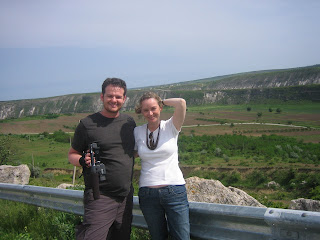 We stopped by the road to appreciate the landscape from afar. On the other side of the river is a village, very pretty too. Natasha took us to a path of grass and collected some plants with a very different – but pleasant smell. She said it’s good for tea, and I got some. We then drive towards the caves, passing by the museum of Orhei Vecchi, but it was closed.


 When I got to the theater, the Awards Ceremony was already happening. So I stood there, waiting it to be finished. I soon spotted Roma, and we went to the outdoor bar next to the theater, where most people were. Roma bought me some delicious tea, and I became aware that Russians love tea, and that’s a popular drink there. It was much better than the Brazilian or American tea. And the waitress gives you some dates and raisins, which were also very good. I became to know better a Serbian filmmaker sitting on the same table, and his girlfriend/wife/film partner, and they were very nice. They studied in Bucharest and told me things I didn’t know about Serbia. Unfortunately I don’t remember our conversation very much, but it just reinforced the idea that people all over the world have the same necessities, everybody goes through difficulties and nothing is perfect.
 Next: the long awaited trip to Oliscani